My Gran's mint brownies are the best thing to eat. I mean, you have to be moderate or they make you sick. But they're soooooooooo good.
Dividing time between my family and Ben's is hard. Especially since I have so many families...Gran, T, the Lovelys, Mom in town, Hannah in town. But we're figuring it out. And hanging out at Ben's family's house.
I wish it would snow again. It got warm on the lovely first day of winter, and all of the snow melted. I need some more snow, to make Christmas even happier.
BeeBoo got a Tigger that bounces on its own. She's between liking it a LOT, and being REALLY scared of it.
I had an epiphany....I realized that I have reached an age at which I no longer care about the presents. It was a good thing to realize. It made me happy to think of all of the things that make me love Christmas, and realize that none of them involved unwrapping things. Well, except watching BeeBoo unwrap them.
My two aunts, my sister and I all married younger men. (This is from the family of women...of Gran, Mom, T, Beanie, Hannah and me...that's four of six) That's somehow telling. What it tells, I've not come up with yet. Ideas?
Monday, December 24, 2007

Saturday, December 15, 2007
I'm so glad to be home
It's so strange. Sometimes I feel like this home-loving behaviour is overly young for my age. But then I realize a couple of things.
1) I haven't had ready access to home in over eight years. So why on earth should I NOT take advantage of being so close?
2) My house in the valley is pretty much the coolest place ever. Now that we've gotten that 6-8 inches they promised in the forecast, we'll be taking BeeBoo to go sled, hike in the snow, see Gran and drink hot chocolate or cider at her house after we get all cold, stuff like that.
3) My family of aunts, uncles, cousins, and a couple of really crazy sisters just make me happy. They all made me who I am, and I'm glad of it.
4) I don't think that the "you can't go home" mentality is valid. I mean, we continually grow and change, and home changes when we're not there. But that doesn't mean that we have to be traumatized about change (even traumatic ones like my parents getting divorced and moving away, thus leaving the house occupied by people only marginally related to me even though Mom still owns it...long story....). Just go with it, learn from it, make it part of the file you can access to help other people be happy.
5) I can't think of 5. So there'll just be 4.
I love home. And I'm so glad that in conjunction with the trip is a vacation. I've needed one for a while now. Maybe that's one of the other positive associations that makes me loves home.
1) I haven't had ready access to home in over eight years. So why on earth should I NOT take advantage of being so close?
2) My house in the valley is pretty much the coolest place ever. Now that we've gotten that 6-8 inches they promised in the forecast, we'll be taking BeeBoo to go sled, hike in the snow, see Gran and drink hot chocolate or cider at her house after we get all cold, stuff like that.
3) My family of aunts, uncles, cousins, and a couple of really crazy sisters just make me happy. They all made me who I am, and I'm glad of it.
4) I don't think that the "you can't go home" mentality is valid. I mean, we continually grow and change, and home changes when we're not there. But that doesn't mean that we have to be traumatized about change (even traumatic ones like my parents getting divorced and moving away, thus leaving the house occupied by people only marginally related to me even though Mom still owns it...long story....). Just go with it, learn from it, make it part of the file you can access to help other people be happy.
5) I can't think of 5. So there'll just be 4.
I love home. And I'm so glad that in conjunction with the trip is a vacation. I've needed one for a while now. Maybe that's one of the other positive associations that makes me loves home.
Saturday, December 8, 2007
Oh, how I love my BeeBoo
When I leave for school in the morning, BeeBoo is usually playing with loads of toys and almost too busy to notice when I say "Give mamma kisses," grab my bag and say bye as I run out the door to catch the bus.
Today, I was busy shuffling outgrown baby clothes around and putting unorganized ones into empty diaper boxes. (Yes, anything to avoid the final papers...) I was really distracted, lots like BeeBoo is in the morning when I leave. So she comes up to me and says "kisses." I was surprised, because I usually have to swindle kisses out of her, and she hardly ever initiates them. So I gave her kisses, all excited because she loved me. Then she grabbed my bag, said "ba bye" and walked to the door.
She was reenacting our morning routine, but with roles reversed. Ben about died, and I thought it was totally hilarious. :-)
Here's a picture...
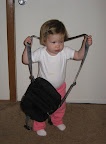
Today, I was busy shuffling outgrown baby clothes around and putting unorganized ones into empty diaper boxes. (Yes, anything to avoid the final papers...) I was really distracted, lots like BeeBoo is in the morning when I leave. So she comes up to me and says "kisses." I was surprised, because I usually have to swindle kisses out of her, and she hardly ever initiates them. So I gave her kisses, all excited because she loved me. Then she grabbed my bag, said "ba bye" and walked to the door.
She was reenacting our morning routine, but with roles reversed. Ben about died, and I thought it was totally hilarious. :-)
Here's a picture...
Friday, December 7, 2007
SNOW!
The first snow of the season has officially hit us. BeeBoo hasn't noticed yet. I'm wondering what will happen when she does.
The snow affects me in several ways.
1) I love the way the world looks when it's white. Being in the Midwest, it's that "stick to everything" snow that makes every tree branch look lacy. LOVE IT!
2) I don't want to do any work. I want to play in the snow. This is potentially problematic, seeing as how in the last three days I've not made any progress on either of my final papers that are due on Wednesday.
3) Drastic reduction in bus crowds, and class size. And I sure won't complain about that one.
4) I want to go home. It's more like Christmas now. Can't I just be done without all this giving finals and writing papers stuff??
I love the snow. It makes me happy.
The snow affects me in several ways.
1) I love the way the world looks when it's white. Being in the Midwest, it's that "stick to everything" snow that makes every tree branch look lacy. LOVE IT!
2) I don't want to do any work. I want to play in the snow. This is potentially problematic, seeing as how in the last three days I've not made any progress on either of my final papers that are due on Wednesday.
3) Drastic reduction in bus crowds, and class size. And I sure won't complain about that one.
4) I want to go home. It's more like Christmas now. Can't I just be done without all this giving finals and writing papers stuff??
I love the snow. It makes me happy.
Wednesday, December 5, 2007
2nd Pullman Book
Yes, I finished yet another children's novel. How go the final papers you ask? Not burning through them nearly as quickly as through the children's fiction.
So. My two critique approach was too time-consuming, so I'll just blurt it all out at once for this one. The second book ("The subtle knife") brings in a whole bunch of new philosophical questions. One of the most interesting is the worth of human experience/having a body. One of the witches (I like them...if I were in that world, I'd want to be one; they only have girl witches) at one point in the novel breaks off some "cloud pine" from the branch she's using to fly and notices the beauty of being able to crush and smell it, and notes that angels, who have no bodies, must really be missing out on things like smelling pine and feeling cold. Coming from a girl that used to run rampant and barefoot through pine and deciduous woods in the backyard, I could sympathize with the thought. Thought it was interesting coming from someone who doesn't share an LDS interpretation of mortal experience. That said, if all you think there is, is this life, chances are good you're going to take notice of little things a bit more.
The female circumcision thing I mentioned in the last post was a passing reference. (Also brought out by one of the witches) I still don't know how appropriate even the reference is, though. It's a heavy issue for adults, let alone pre-pubescent kids.
My favorite character died in this book. Sad day on that one. However, he paints a great picture about how being a parent has less to do with genetics than with love. I liked him.
Same general literary notes, with one addition about framework. Part of the current "controversy" about the movie and books lies in the fact that Pullman at one point said "My books are about killing God," but now that the movies are coming out has changed his tune to one of "it's entertainment...I didn't write it as a sermon" kind of thing. (The first one is an actual quote, the second is more a paraphrase) Interestingly enough, however, at least up to this point the books are based on the rhetoric (good v. evil) and construction of reality (the Fall must be bad, not part of the plan, and Eve brought sin into the world...that one's a whole different post) purported by the Catholic church. A shaman character points out that on one side is the part of existence that wants humans to know things, progress, and enjoy human experience; the other side wants humility and submission. That's a very medieval Catholic (note I didn't say "medieval, Catholic"...the Catholic church has changed A LOT since when they burned people for reading/researching/asking questions) dichotomy. By buying into that construction, the author lends it credibility/power. As of the end of book 2, the world is lining up for another battle between rebel angels and "The Authority" (God), and all involved parties on both sides. The "bad guys" want to prevent another Fall, while the "good guys" say it's necessary. Why redo history within the existing framework? Why not create a new one?
Of course, my perception of this comes from my firm belief that "secular" learning and "religious" learning complement each other, and my LDS perception of the Fall as part of the plan. So I want him to write books that work THAT way.
But, having read this book, if I were Catholic I don't think I'd want my kids to read it. There's too much open association of Catholicism with oppression and limitation, and even torture, which I (even not being Catholic) don't think is a fair appraisal of the situation. There are people who say that Pullman is more anti-establishment in general. The problem is that the only "establishment" he's painted so far is the Church and it's extensions. So. I'm not going to check the next book out of the library until my papers are done. :-)
So. My two critique approach was too time-consuming, so I'll just blurt it all out at once for this one. The second book ("The subtle knife") brings in a whole bunch of new philosophical questions. One of the most interesting is the worth of human experience/having a body. One of the witches (I like them...if I were in that world, I'd want to be one; they only have girl witches) at one point in the novel breaks off some "cloud pine" from the branch she's using to fly and notices the beauty of being able to crush and smell it, and notes that angels, who have no bodies, must really be missing out on things like smelling pine and feeling cold. Coming from a girl that used to run rampant and barefoot through pine and deciduous woods in the backyard, I could sympathize with the thought. Thought it was interesting coming from someone who doesn't share an LDS interpretation of mortal experience. That said, if all you think there is, is this life, chances are good you're going to take notice of little things a bit more.
The female circumcision thing I mentioned in the last post was a passing reference. (Also brought out by one of the witches) I still don't know how appropriate even the reference is, though. It's a heavy issue for adults, let alone pre-pubescent kids.
My favorite character died in this book. Sad day on that one. However, he paints a great picture about how being a parent has less to do with genetics than with love. I liked him.
Same general literary notes, with one addition about framework. Part of the current "controversy" about the movie and books lies in the fact that Pullman at one point said "My books are about killing God," but now that the movies are coming out has changed his tune to one of "it's entertainment...I didn't write it as a sermon" kind of thing. (The first one is an actual quote, the second is more a paraphrase) Interestingly enough, however, at least up to this point the books are based on the rhetoric (good v. evil) and construction of reality (the Fall must be bad, not part of the plan, and Eve brought sin into the world...that one's a whole different post) purported by the Catholic church. A shaman character points out that on one side is the part of existence that wants humans to know things, progress, and enjoy human experience; the other side wants humility and submission. That's a very medieval Catholic (note I didn't say "medieval, Catholic"...the Catholic church has changed A LOT since when they burned people for reading/researching/asking questions) dichotomy. By buying into that construction, the author lends it credibility/power. As of the end of book 2, the world is lining up for another battle between rebel angels and "The Authority" (God), and all involved parties on both sides. The "bad guys" want to prevent another Fall, while the "good guys" say it's necessary. Why redo history within the existing framework? Why not create a new one?
Of course, my perception of this comes from my firm belief that "secular" learning and "religious" learning complement each other, and my LDS perception of the Fall as part of the plan. So I want him to write books that work THAT way.
But, having read this book, if I were Catholic I don't think I'd want my kids to read it. There's too much open association of Catholicism with oppression and limitation, and even torture, which I (even not being Catholic) don't think is a fair appraisal of the situation. There are people who say that Pullman is more anti-establishment in general. The problem is that the only "establishment" he's painted so far is the Church and it's extensions. So. I'm not going to check the next book out of the library until my papers are done. :-)
Tuesday, December 4, 2007
Zayas
I love Maria de Zayas. Reading her novelas amorosas doesn't exactly make me happy (lots of them are about women whose husbands beat them or leave them or worse), but her premise does. At least some of the women get away. And that makes me happy.
One of the guys in the class said that Zayas bores him. Sad, sad day. Even if you don't like Zayas, I don't see how she's more boring than any other Golden Age literature...
Hooray for women who write...and women's space. :-)
One of the guys in the class said that Zayas bores him. Sad, sad day. Even if you don't like Zayas, I don't see how she's more boring than any other Golden Age literature...
Hooray for women who write...and women's space. :-)
Monday, December 3, 2007
"Golden Compass" update
So, I finished the first book in the "controversial" series that I've been ranted at and ranted about.
I'll give a breakdown as a normal reader, and then as a literature student (because they're really different interpretations).
Normal person critique:
The plot was incredibly engaging (the sit down and read for three hours straight, grip the chair arm kind of interest). The writing is really tightly structured, and unlike some fantasy authors (ie, Robert Jordan), characters mentioned at an early point in the book show up again soon enough to be useful (the mystery of a little boy who disappeared in one of the early chapters was resolved within enough time that the reader remembers who he was and when the author mentioned him....also very un-Jordan-esque, and good for that reason). This new world is incredibly imaginative, sharing enough characteristics with ours to be understandable, but new enough to be fascinating. The protagonist is approachable and likeable. She's a little girl with (at least apparently) no parents who has been left at a university in care of the professors (but they're called "Scholars") there. How that happened comes to light at the end, and is plausible. My first thought was "yeah, professors taking care of an orphan girl just because....riiiiiiight." She teaches kids that the ideas of children can be big ideas, and that kids can empower themselves or limit themselves based on correct or inappropriate choices. Really good. She teaches kids to think. One problematic characterization is that she's a liar. That's one of the main adjectives they describe her with throughout the book. She usually only lies to people who are out to get her, though. So who knows on that one. In terms of the crisis over religion, I can see where Catholics would be REALLY upset over this book. The fictional Magisterium is reigned over by the "Vatican council." And they're the bad guys. Close enough to home to cause some problems there, I'd think. However, from an LDS perspective, there are some interesting potential differences in interpretation. This girl is a pre-teen. When she figures out that the people claiming to do good through religion are really doing bad things, she questions it. Reminiscent of anyone we know and love? I think so. Just some things to keep in mind.
Literature student critique: Amazingly precise prose, wonderful vocabulary with potential to enrich the language capabilities of students. Conveys exact meanings through wonderful word choice. A bildungsroman, similar in some ways to the Harry Potter story and very much in the pattern of the "hero of a thousand faces" defined by Joseph Campbell (a little girl that will save the world, but doesn't know it, in fact can't know it or all is lost...etc). The idea of daemons (a sort of external expression of the soul) was REALLY interesting to me at the beginning. I think, though, that at least some critics would link them to sexuality or even sex itself. That's the interpretation that I'm attaching to them at this stage. In this light, the fact that the Church tries to separate children from their daemons is disturbing. If the author's intent is to preach that all Christianity (or organized religion) would eliminate sexuality given the chance, I'll have issues with him. Even more problematic is a scene in which Lyra (the little girl protagonist) is struggling to get away from a group of "scientists" and they seize her daemon (forbidden in the world of the story through protocol, forbidden in literature because of the implications of rape) and render her incapable of fighting. If a child were to make the association (which I doubt most would, but some could) between that action and rape or molestation, that scene would be particularly disturbing. The dichotomy of rejection of the mother and idealization of the father by Lyra is highly reminiscent of Freudian thought (I spit in disgust at his name...right AL? :-) The last ten pages or so are FULL of sexual imagery. Again, most kids won't get it. They'll see an avalanche as an avalanche, the daemons of two adults interacting as similar to previous "establishing authority" interactions shown in the text, etc. But some kids might get it. So. Give it to older teens, not to ten-year-olds.
So. That's it. There'll be more. Especially given the fact that in the first twenty pages of the second novel (which I started last night), they take up the issue of female circumcision...a little dense for kids' fiction, don't we think??
I'll give a breakdown as a normal reader, and then as a literature student (because they're really different interpretations).
Normal person critique:
The plot was incredibly engaging (the sit down and read for three hours straight, grip the chair arm kind of interest). The writing is really tightly structured, and unlike some fantasy authors (ie, Robert Jordan), characters mentioned at an early point in the book show up again soon enough to be useful (the mystery of a little boy who disappeared in one of the early chapters was resolved within enough time that the reader remembers who he was and when the author mentioned him....also very un-Jordan-esque, and good for that reason). This new world is incredibly imaginative, sharing enough characteristics with ours to be understandable, but new enough to be fascinating. The protagonist is approachable and likeable. She's a little girl with (at least apparently) no parents who has been left at a university in care of the professors (but they're called "Scholars") there. How that happened comes to light at the end, and is plausible. My first thought was "yeah, professors taking care of an orphan girl just because....riiiiiiight." She teaches kids that the ideas of children can be big ideas, and that kids can empower themselves or limit themselves based on correct or inappropriate choices. Really good. She teaches kids to think. One problematic characterization is that she's a liar. That's one of the main adjectives they describe her with throughout the book. She usually only lies to people who are out to get her, though. So who knows on that one. In terms of the crisis over religion, I can see where Catholics would be REALLY upset over this book. The fictional Magisterium is reigned over by the "Vatican council." And they're the bad guys. Close enough to home to cause some problems there, I'd think. However, from an LDS perspective, there are some interesting potential differences in interpretation. This girl is a pre-teen. When she figures out that the people claiming to do good through religion are really doing bad things, she questions it. Reminiscent of anyone we know and love? I think so. Just some things to keep in mind.
Literature student critique: Amazingly precise prose, wonderful vocabulary with potential to enrich the language capabilities of students. Conveys exact meanings through wonderful word choice. A bildungsroman, similar in some ways to the Harry Potter story and very much in the pattern of the "hero of a thousand faces" defined by Joseph Campbell (a little girl that will save the world, but doesn't know it, in fact can't know it or all is lost...etc). The idea of daemons (a sort of external expression of the soul) was REALLY interesting to me at the beginning. I think, though, that at least some critics would link them to sexuality or even sex itself. That's the interpretation that I'm attaching to them at this stage. In this light, the fact that the Church tries to separate children from their daemons is disturbing. If the author's intent is to preach that all Christianity (or organized religion) would eliminate sexuality given the chance, I'll have issues with him. Even more problematic is a scene in which Lyra (the little girl protagonist) is struggling to get away from a group of "scientists" and they seize her daemon (forbidden in the world of the story through protocol, forbidden in literature because of the implications of rape) and render her incapable of fighting. If a child were to make the association (which I doubt most would, but some could) between that action and rape or molestation, that scene would be particularly disturbing. The dichotomy of rejection of the mother and idealization of the father by Lyra is highly reminiscent of Freudian thought (I spit in disgust at his name...right AL? :-) The last ten pages or so are FULL of sexual imagery. Again, most kids won't get it. They'll see an avalanche as an avalanche, the daemons of two adults interacting as similar to previous "establishing authority" interactions shown in the text, etc. But some kids might get it. So. Give it to older teens, not to ten-year-olds.
So. That's it. There'll be more. Especially given the fact that in the first twenty pages of the second novel (which I started last night), they take up the issue of female circumcision...a little dense for kids' fiction, don't we think??
Subscribe to:
Posts (Atom)